


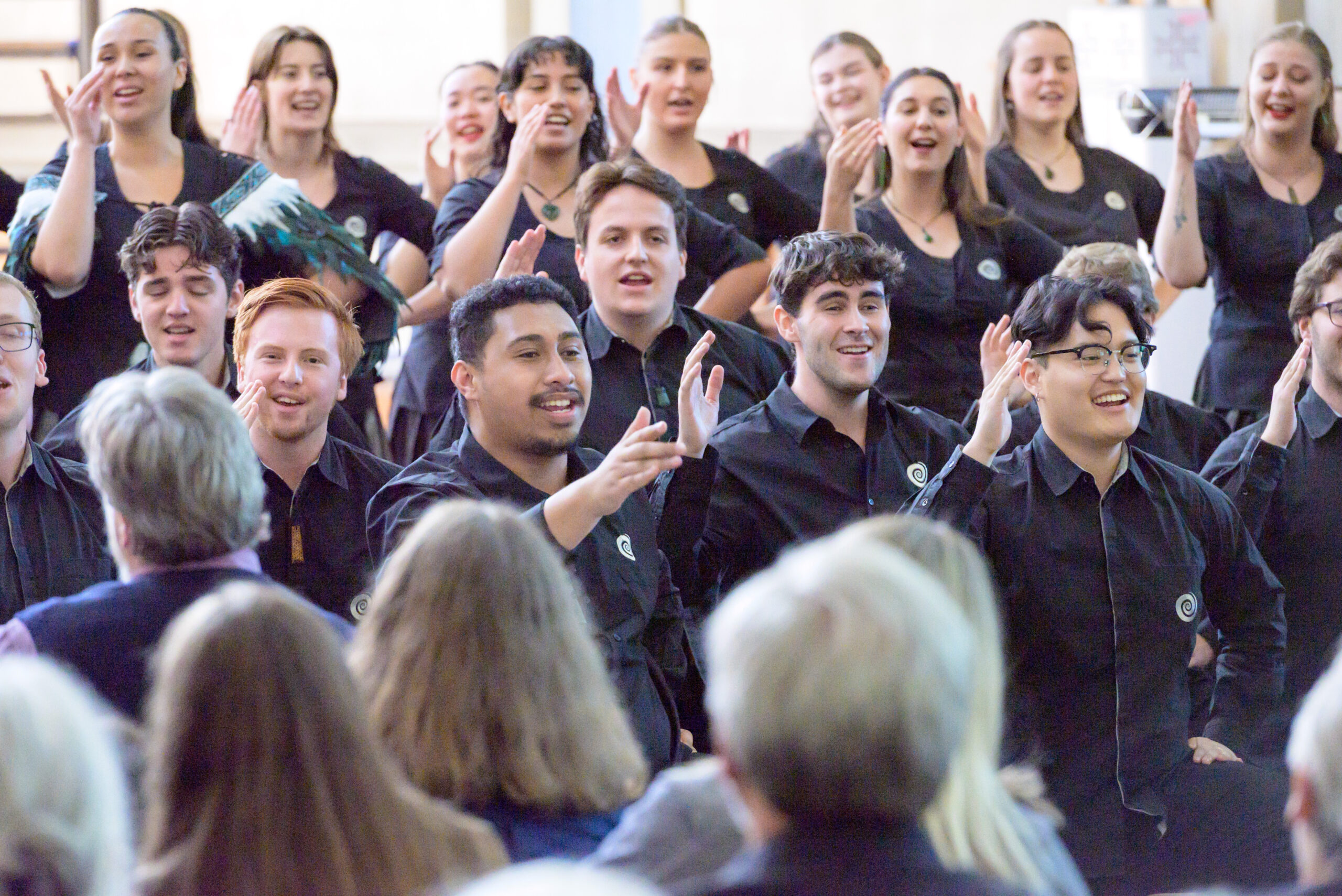
NZ Youth Choir: International Tour Farewell Concert
June 2025
Repertoire
NZYC Programme Notes
He Tamaiti ō te Ao Tukupū* Takerei Komene, Ngāpuhi and Te Whānau-a-Apanui (b. 1999)
He Tamaiti ō te Ao Tukupū was written for choir and organ in 2023 for David Squire and the Auckland Youth Choir. In this song, composer and current choir member, Takerei Komene combines a whakataukī (Māori proverb) with an original pepeha (a Māori form of greeting that includes family, tribe, ancestors and land) that brings people together reminding them that they are loved and have a place in this world.
I am alive. I am loved.
Love is my mountain,
Melancholy is my river
Yearning is my canoe
The family of light are my tribe
The stars are my clan
The skies are my home
The heart is my birthplace.
Seek the treasure that you value most dearly,
if you bow your head, let it be to a lofty mountain.
Gaudeamus Omnes Marek Raczyński (b.1982)
Gaudeamus Omnes by the Polish composer Marek Raczyński was inspired by a Gregorian chant of the same name. The words celebrate the feast of the Assumption of the Virgin Mary and meditate on the joys of humanity intertwined with the voices of the angels.
Let us rejoice in the Lord
On this festive day
In honour of the blessed Virgin Mary.
In whose assumption the Angels rejoice
And give glory to the Son of God!
Alleluia!
Os Justi Anton Bruckner (1824-1896)
This four-part motet was composed by Bruckner in 1879, the year he began his Sixth Symphony. Written in the Lydian mode, it displays Bruckner’s deep understanding of renaissance polyphony. Dedicated to his friend Ignaz Traumihler, a follower of the Cecilian movement, Bruckner wrote this motet according to the movement’s tenets where everything is required to be diatonic. Os Justi treats us to lush harmonies and soaring lines without using a single sharp or flat.
The mouth of the righteous utters wisdom
And his tongue speaks what is just.
The law of God is in his heart
And his feet do not falter.
Alleluia.
Psalm 37: 30-31
Das ist meine Freude (Johann Ludwig Bach) MJS
J L Bach was a third cousin of the illustrious Johann Sebastian Bach, and served as Kapellmeister at Meiningen in central Germany. This piece for double choir is a joyful setting of the final verse of Psalm 73, featuring a quirky stuttering motive at the opening and much antiphonal dialogue between the two choirs.
Das ist meine Freude, daß ich mich zu Gott halte und meine Zuversicht setze auf den Herren.
This is my joy, that I cling to God and set my trust in the Lord. This is my joy.
Text: Psalm 72:28
Kyrie from Cantus Missae, Op.109 (Josef Rheinberger) MJS
Arguably Liechtenstein’s most famous musician, Rheinberger spent most of his career as court composer in Munich and as a notable composition teacher (Richard Strauss was one of his students). Aside from a tremendous output of organ music it is for his sacred choral music that he is particularly famed, notably the beautiful Abendlied and the Cantus Missae, his mass for double choir. The “Kyrie” is a perfect assimilation of renaissance polyphony and romantic harmony.
Kyrie eleison. Christe eleison. Kyrie eleison.
Lord, have mercy. Christ, have mercy. Lord, have mercy.
Beata Virgo (David Griffiths)* MJS
David Griffiths is one of New Zealand’s finest choral composers with an impressive catalogue of mostly sacred a cappella works. “Beata Virgo”, taken from the set O Magnum Mysterium (1974) is perhaps his most frequently performed and recorded piece. It is sumptuously scored for twelve-part choir, using overlapping and phasing techniques to create a mystical ambience.
Beata Virgo cujus viscera meruerunt portare Dominum Christum.
O blessed virgin, whose womb was worthy to bear the Lord Jesus Christ.
Text: Matins responsory for Christmas Day
The Battle of Jericho arr. Moses Hogan (1957-2003)
Moses Hogan was a composer celebrated for his arrangements of spirituals. His vibrant and energetic setting of The Battle of Jericho is a song of protest that professes faith and celebrates the breaking down of walls and obstacles.
Hymne au Soleil Lili Boulanger (1893-1918)
The celebrated French Composer Lili Boulanger, whose life was sadly cut short at the age of 25, composed this piece originally for mezzo-soprano solo, female chorus, and orchestra in 1912. An early work, it shows Boulanger’s impressionist style full of the harmonic innovations that led her to be the first female to be awarded the Prix de Rome in 1913. Hymn au Soleil, set to a poem written by Casimir Delavigne, celebrates the power of the sun at dawn with radiant harmonies evoking images of the sun being drawn by horses across the sky.
Du soleil qui renaît [bénissons] la puissance.
Avec tout l’univers célébrons son retour.
Couronné de splendeur, il se lève, il s’élance.
Le réveil de la terre est un hymne d’amour.
Sept coursiers qu’en partant le Dieu contient à
peine,
Enflamment l’horizon de leur brûlante haleine.
O soleil fécond, tu parais!
Avec ses champs en fleurs, ses monts, ses bois
épais,
[La] vaste mer de tes feux embrasée,
L’univers plus jeune et plus frais,
Des vapeurs de matin sont brillants de rosée.
Let us bless the power of the reborn sun.
With all the universe let us celebrate its return.
Crowned with splendor, it rises, it soars.
The waking of the earth is a hymn of love.
Seven rushing steeds that the God scarcely holds back
Ignite the horizon with their scorching breath.
Oh, vivid sun, you appear!
With its fields in bloom, its mountains, its thick
forests,
The vast sea set ablaze by your fires,
The universe, younger and fresher,
The vapours of morning are glistening with dew.
Poem by Casimir Delavigne (1821)
Cocks Crow and There’s a Time, Childhood Jenny McLeod (1941-2022)*
Jenny McLeod ONZM was a well known New Zealand composer and long time professor of music at Victoria University of Wellington. Childhood (1981) has always been a favourite of the New Zealand Youth Choir. Set to poems written by the composer, McLeod takes us on a journey through the joys and frustration of childhood. “Cocks Crow” is a rhythmic ode to the childlike excitement of starting the day and “There’s a Time”, based on Ecclesiastes 3:1-8, is a lullaby assuring us that there is a time and place for everything.
In Youth is Pleasure Herbert Howells (1892-1983)
In Youth is Pleasure, is a madrigal by British composer Herbert Howells. It was composed in 1915, the day after his twenty-third birthday. It talks of youthful high spirits and indulgence.
In a harbour grene aslepe whereas I lay,
The byrdes sang swete in the middes of the day,
I dreamed fast of mirth and play:
In youth is pleasure, in youth is pleasure. Methought I walked still to and fro,
And from her company I could not go-
But when I waked it was not so:
In youth is pleasure, in youth is pleasure. Therefore my hart is surely pyght
Of her alone to have a sight
Which is my joy and hartes delight:
In youth is pleasure, in youth is pleasure.
Text: Robert Wever (c.1550)
How do you keep the music playing? Michel Legrand (1932-2019)
arr. Alexander L’Estrange (b.1974)
How Do You Keep the Music Playing? was composed by Michel Legrand, with lyrics by Alan And Marilyn Bergman for the 1982 film Best Friends, and was nominated for Best Original Song in the 1983 Academy Awards. This arrangement is by well-known British choral composer Alexander L’Estrange.
Karanga Patricia Te Ariki & Tuirina Wehi*
This karanga (call) was written for the 2020-2022 NZYC in 2022 by Patricia Te Ariki and adapted by Tuirina Wehi for the 2023-2025 NZYC. The words greet all gathered from near and far to witness the choir, this taonga (treasure), welcoming them in.
Ko ngā waka ēnei Traditional mōteatea*
This mōteatea (chant), celebrates the great waka that travelled from Hawaiki, the traditional and spiritual home of the Māori people, to Aotearoa.
Kua Rongo Ngāpō (Bub) Wehi*, Ngāi Tūhoe, Te Whakatōhea, Ngāpuhi & Te Whānau-a-Apanui (1934-2016)
This waiata (song), was written by Ngāpō (Bub) Wehi, and gifted to the NZYC by Te Whānau Wehi. It calls all the peoples of the world to come together in this spirited song that ends with a haka.
Ua Fetausunu’i Ao Traditional Samoan, arr. Igelese Ete*
Former NZ Youth Choir member Tuilagi Dr Ingelese Ete arranged this piece for the NZYC in 2023. His arrangement of the traditional Samoan song Ua Fetausunu’i Ao uplifts and celebrates with gratitude and appreciation the people and islands of Samoa.
Isa Isa Vulagi Lasa Dina Traditional Fijian/Tongan, arr. Siliva Gaugatao*
The Fijian farewell song, also known as Isa Lei, was arranged for NZYC by the choir’s cultural consultant for the 2019 Pacific Tour, Tofilau Niulevaea Dr Siliva Gaugatao. The origin of this song is disputed. Some believe it is a Tongan love song written in 1915 for Princess Sālote. A visiting Fijian Sergeant heard it, and took it back to Fiji, changing the words into the Fijian song we know today. Others believe it was written by Ratu Tevita Uluilakeba, father of the first Prime Minister of an independent Fiji, Ratu Sir Kamisese Mara in 1916; however, the manuscript suggests it was 1918. Whatever the origin, Isa Lei is loved and performed worldwide.
Aotearoa Tuirina Wehi*
Aotearoa is the first waiata written specifically for the NZYC. This waiata ā-ringa (action song) was written by Tuirina Wehi, granddaughter of Ngāpō and Pimia Wehi. The cultural leaders of the NZYC met with Turina and it was decided that the theme of this waiata should be one of hope and kotahitanga (unity, and solidarity). Aotearoa acknowledges that the land is our home and a taonga (treasure) and asks us to look after the land for future generations.
He rau noa au nō Te Waka-a-Māui e takoto ake nei e!
He unahi noa au nō Te Ika-a-Māui e ngāueue ana e!
Ko Aotearoa tōku kāinga
Ōna kakara, ōna Mārietanga!
Tōna mauri, kāore he ātaahua i kō atu
Aotearoa
Kura whakahirahira – ko koe tēnā!
Taku tūrangawaewae! Taumata okioki!
Te ihi, te wehi, te tapu, te mana – ko koe tēnā, Aotearoa!
Te Tai Tokerau
Tāmaki Herenga Tāngata
Tāmaki Herenga Waka
Tāmaki Makaurau!
Karanga rā!
Hauraki-Waikato
Te Tai Hauāuru
Waiariki
Ikaroa-Rāwhiti
Te Tai Tonga!
Aotearoa! Karanga rā! (Interjection: Haere mai!)
Ko te wai te toto o te whenua
Ko te whenua te toto o te tangata
Toitū he whenua, whatungarongaro he tangata
Kia whakarongo te taringa ki te waha o Tāne e kō i te ata.
Ko Aotearoa te whenua taurikura
Kauria ai ngā wai aroha nō te itinga
Ngā kura mahara ka pūmau rā
Aotearoa – karanga rā!
Takahia! Takahia te nuku o te whenua!
Hī! Hā! Hī! Auē! Hī!
I am but a feather of Te Waka-a-Māui lying here beneath me
(The Waka of Māui = South Island)
I am but a scale of Te Ika-a-Māui that is trembling!
(The Fish of Māui = North Island)
Aotearoa is my home
Its pleasant fragrances, its peacefulness
Its life force, there is nothing more beautiful
(Than) Aotearoa
Magnificent treasure – that is you!
My place to stand! My great resting place!
The excitement, the awe, the sacredness, the mana – that is you, Aotearoa!
The North Coast
Tāmaki, the gathering place of many people
Tāmaki, the gathering place of many waka
Tāmaki of many lovers!
Call to me!
South Auckland – Waikato
West Coast
Bay of Plenty
Eastern North Island
The south coast!
Aotearoa! Call to me!
Water is the blood of the land
The land is the blood of the people
The land is permanent, people disappear from sight
Let the ear listen to the mouth of Tāne chirping in the morning
(Tāne = god of the forest)
Aotearoa the prosperous land
Always swimming in the waters of love from childhood
The precious memories, remain permanent (hold fast to them)
Aotearoa – call to me!
Walk! Walk the extent, the length and breadth of the land!
Ururangi from Matariki He Kāhui Reo* Anthony Ritchie
“Ururangi” is part of Matariki He Kāhui Reo, a ground-breaking multi-choir work written for the recent 2024 World Choir Games in Auckland. The work celebrates the nine stars of the Matariki cluster. The NZ Youth Choir represented the star Ururangi in a piece written by Anthony Ritchie and set to texts by Ataahua Papa and Rangiamoa of Ngāti Apakura. Ururangi is the star in the Matariki cluster that is associated with the winds. The song begins with the northern breeze blowing accompanied by the lament of Rangiamoa on the death of her cousin Te Wano and the fate of all her people who have been lost in the 1864 battle of Ōrākau in the Waikato.
The Passing of the Year Jonathan Dove (b.1959)
Known primarily as a composer of opera, the Englishman Jonathan Dove has also written a large collection of choral music. His writing is modal and rhythmic, taking its inspiration from the classical music of North India and the American minimalist styles of the 1960s and 1970s. The Passing of the Year was written in 2000 and is a work for double chorus and piano set to poetry by William Blake, Emily Dickinson, George Peele, Thomas Nash and Alfred Lord Tennyson. The poems take the listener on a journey from the first buds of spring, to the heat of summer, followed by a Kyrie asking for mercy as autumn takes hold, and finally to the depths of a northern winter that rings in the new year with a call for peace.
E Te Ariki from A Westlake Mass* David Hamilton (b.1955)
David Hamilton is one of New Zealand’s most prolific and well known composers of choral music. He composed A Westlake Mass in 2018 for the choirs of Westlake Girls and Boys High Schools – Choralation and Voicemale – to sing on their tour to Italy that year. The Mass was sung at St Peter’s Basilica in Rome. “E te Ariki” is the te reo Maori translation of the Kyrie movement.
E te Ariki, tohungia rā mātou
E te Karaiti, tohungia rā mātou
E te Ariki, tohungia rā mātou
Lord, have mercy. Christ, have mercy. Lord, have mercy.
They say it’s wonderful Irving Berlin (1888-1989),
arr. Steve Zegree (1953-2015)
This popular song by Irving Berlin from the musical Annie Get Your Gun (1946) was originally sung by Ethel Merman and Ray Middleton. It has now become a jazz standard and in this arrangement by Steve Zegree is full of expressive vocal lines and jazz textures.
Ka Waiata ki a Maria* Richard Puanaki, Ngāti Kahungunu (1949-2021)
This waiata (song) has become central to the choral canon of Aotearoa New Zealand. This prayer to the Virgin Mary describes her as becoming the house of mankind and the mother of the world.
Ka waiata I sing
Ki a Maria To Mary
Hine i whakaae The woman who agreed
Whakameatia mai To bring forth life
He whare tangata From her womb (the house of mankind)
Hine purotu Woman who acquiesced
Hine ngākau Woman of passion Hine rangimārie Woman of peace
Ko te Whaea She is the Mother
Ko te Whaea She is the Mother
O Te Ao Of the world
We will remember them Edward Elgar (1857-1934)
This setting of Laurence Binyon’s famous Ode is from Elgar’s With Proud Thanksgiving, which itself was an abridged version of “For the Fallen” from his large-scale work The Spirit of England written during World War I. The simple and poignant arrangement for a cappella choir is by Ian Tracey.
They shall grow not old, as we that are left grow old:
Age shall not weary them, nor the years condemn.
At the going down of the sun and in the morning
We will remember them.
Text: Laurence Binyon (1914)
Programme notes by Dr Morag Atchison and Michael Stewart.
About the choir
The New Zealand Youth Choir (NZYC) has achieved considerable success since its formation in 1979. Performances in New Zealand and thirteen international tours including visits to the UK, Europe, Canada, USA, Australia, Singapore, Russia, the Republic of Korea, China and the Pacific Islands have firmly established its reputation for consistency, energy and excellence. The Choir is comprised of around fifty 18 to 25-year-old singers and operates on a 3-year audition cycle.
Did you enjoy the concert? Please give us your feedback
Artistic Staff
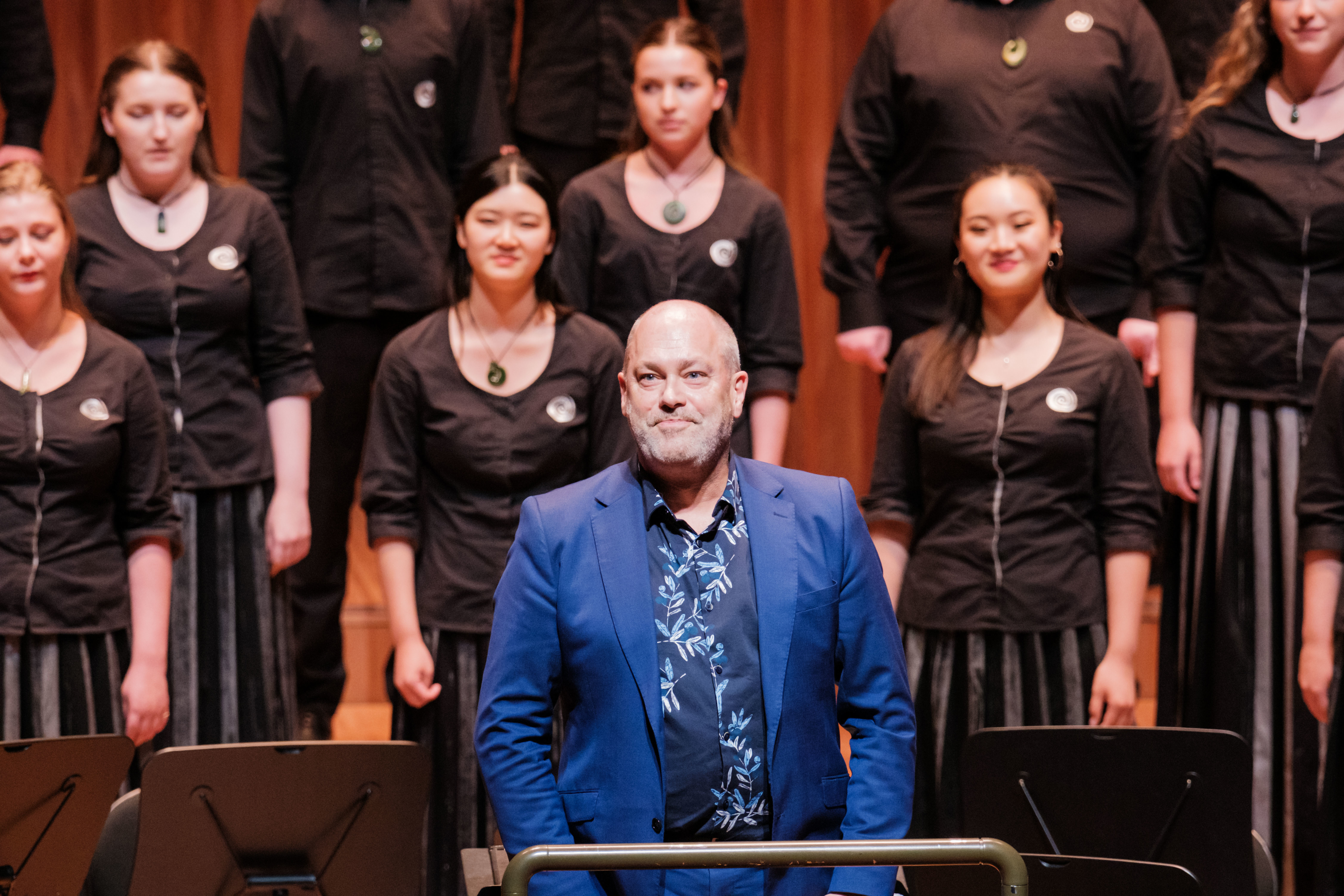
DAVID SQUIRE is one of New Zealand’s most prominent conductors. A founding member and current chair of the NZ Association of Choral Directors, he is also a national conducting advisor and tutor, and a Board member for the NZ Choral Federation.
Graduating from the University of Auckland with a Master of Music degree with first class honours, David has sung with many top choirs in New Zealand, including the Auckland Dorian Choir, Auckland Chamber Choir and NZYC. He was also a founding member of Voices New Zealand Chamber Choir and the V8 Vocal Ensemble.
David has taught music in secondary schools for 30 years, directing choirs, orchestras and bands, including many groups that have won local, national and international awards. David also takes workshops and professional development courses throughout the country. David is often involved in session and recording work, including a tour with George Benson as backing vocalist in 2010. He was the choral adjudicator and clinician at the Rhapsody Rotorua festival for four years.
In 2011 he directed training workshops for choirs singing the anthems at the Rugby World Cup, and then conducted anthem choirs at 7 matches. In 2017 he was the guest conductor for the mixed honour choir at the AMIS Choral Festival in Abu Dhabi. Since 2018 he has been the choral director of the annual ISCMS festival in China. In 2019 he served on the jury for the 1st Asia Choral Grand Prix in Manila, Philippines.
In 2011 he was awarded a New Zealander of the Year Local Heroes Medal for services to music education.

MICHAEL STEWART is one New Zealand’s leading choral conductors and organists. He is Organist and Director of Music at the Wellington Cathedral of St. Paul, Deputy Music Director of the New Zealand Youth Choir, and Music Director of acclaimed early music choir The Tudor Consort. Michael holds a Bachelor of Music degree with First Class Honours from the University of Canterbury and a Master of Music degree from McGill University. He has recorded for the Canadian Broadcasting Corporation and is a frequent contributor to Radio New Zealand Concert. Since becoming Music Director of The Tudor Consort in 2007, Michael has led critically-acclaimed performances of Handel’s Messiah, Israel in Egypt and J S Bach’s Christmas Oratorio, and has prepared them for several performances of Handel’s Messiah with the NZSO. In 2021 Michael prepared Voices New Zealand for a performance of Brahms’ Schicksalslied. He is a past member of both the New Zealand Youth Choir and Voices New Zealand.
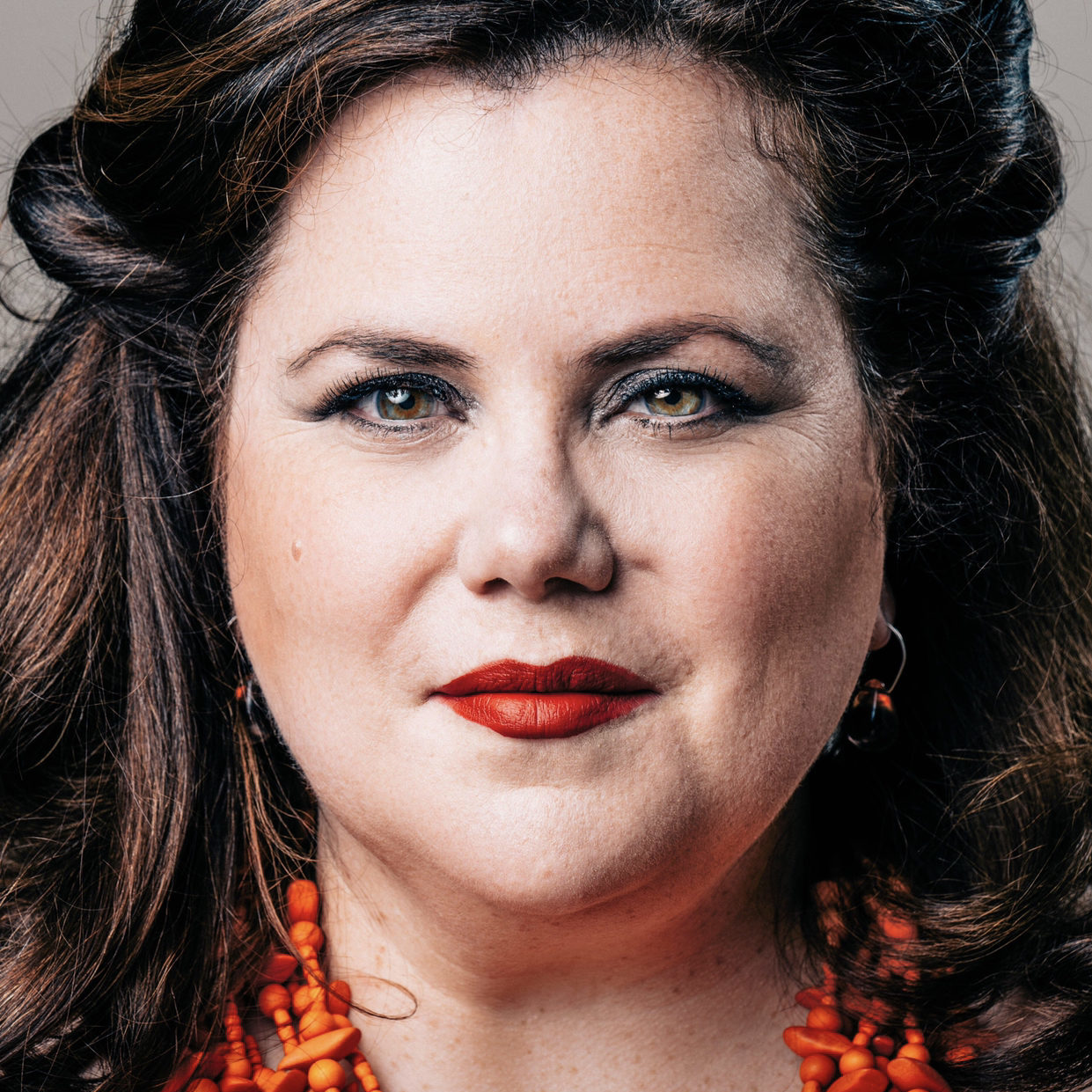
Morag Atchison has firmly established herself as one of New Zealand’s leading sopranos, pedagogues, and choral educators. She studied at the University of Auckland and Royal Academy of Music (London) and was a finalist in the Kathleen Ferrier and Royal Over-Seas League Competitions. She has performed operatic roles including Berta, The Barber of Seville (NZ Opera) Helmwige, Die Walküre (NZSO); Lady-in-waiting, Verdi’s Macbeth; First Lady, Magic Flute (NBR NZ Opera); Fourth Maid, Strauss’ Elektra (APO); Blumenmädchen, Parsifal (NZSO); Annina, La traviata (English Touring Opera) and Sandrina, La Finta Giardiniera (Opera Unleashed, Hamilton Festival). Morag’s concert engagements include performances of the Britten War Requiem (CSO); Mozart Requiem (Voices NZ and Wellington Sinfonia); Handel’s Messiah (VNZ and WS; Auckland Choral); Verdi Requiem (Bach Musica); Tippett’s A Child of our Time with the NZYC and NZSO-NYO; and Beethoven’s Ah! perfido (APO and Manukau Symphony). In 2018 Morag travelled to England, France, Germany, and Spain as part of Voices New Zealand’s European tour and was a soloist on the soundtrack for the major motion-picture Mortal Engines. In 2022 her debut CD The Distance: Songs of David Hamilton was released on the Atoll label. Morag’s recent engagements include Britten’s War Requiem with Orchestra Wellington and the Orpheus Choir, she was the Guest Artist at the Lockwood NZ Aria Finals in Rotorua, singing with the Auckland Philharmonia, a performance of the Verdi Requiem with Auckland Choral, and a recital as part of the celebrations for the consecration of the Bishop of North Africa in Tunisia. Later in 2025 she will sing with Voices NZ as part of their European Tour.
Morag is a Senior Lecturer in Voice at the University of Auckland, vocal consultant for the acclaimed New Zealand Youth Choir, the University of Auckland Chamber Choir, and for over a decade worked with the award-winning Choralation from Westlake Girls’ and Boys’ High Schools. She was a regional judge for 2023 The Big Sing choral competition and in 2025 will be the judge for The Big Sing’s Cadenza festival. In 2013 Morag was awarded a Doctorate in Musical Arts from the University of Auckland, the first DMA in vocal studies from a New Zealand University. In 2019 she was elected as an Associate of the Royal Academy of Music (ARAM).
Click here for the 2025 NZ Youth Choir members
History of the choir
1979: The ‘National Youth Choir’ of New Zealand is founded by Guy Jansen. As Music Director he invites Peter Godfrey as Guest Conductor.
1982: NYC performs at Wembley with Kiri Te Kanawa during their first international tour.
1983: Prof Peter Godfrey is appointed Music Director.
1988: During the 2nd international tour to Europe NYC wins Best Choir at the International Festival of Youth and Music in Vienna and two second places at the Llangollen International Musical Eisteddfod.
1989: Karen Grylls became Music Director.
1999 NYC celebrates its 20th anniversary in Wellington with a concert with the New Zealand Symphony Orchestra.
One of the Choir’s greatest achievements was winning the ‘Choir of the World’ title at the International Music Eisteddfod in Llangollen, Wales. A week later they won the ‘Grand Prix Slovakia’. The tour also included Ireland, the Czech Republic, Vienna, London and Singapore.
2001: Now renamed New Zealand Youth Choir, the Choir undertook an international tour to Texas, USA.
2004: On their tour of Europe, the NZYC achieved highest marks in several categories at the 43rd Int. Choral Competition in Gorizia, Italy. The Choir recorded a new CD, Gaude, which was released to critical acclaim in June.
2005: Gaude was nominated as finalist in the Best Classical Album category at the 2005 NZ Music Awards.
2007: NZYC returned from an award-winning tour through Canada, the UK and Spain, having taken podium placings at two International Choral Competitions in Llangollen, Wales and Cantonigros, Spain, including winning the Mixed Choir category.
2009: was NZYC’s 30th Anniversary. The Choir toured to Invercargill, Gore, Dunedin, Kapiti, Palmerston, Wellington, Warkworth and Auckland, reinforcing its truly national nature.
2010: On its international NZYC performs at the World Expo in Shanghai, Singapore, Seoul, Brisbane, Canberra and Sydney.
2011: David Squire became Music Director.
2013: At the end of 2013 the Choir undertook a much acclaimed three-week tour of the USA and Canada performing in Los Angeles, Toronto, Ottawa, Montreal, Boston, New York and Washington.
2014: In February NZYC performed in the NZ Festival in Wellington – ‘…this concert was a timely reminder of the quality of choral singing we have in this country.’ Dominion Post
2016: During its 2016 European Landmark Tour, NZYC won the GRAND PRIX at the 2016 IFAS in Pardubice Czech Republic and also all four categories it competed in.
2019: 40th anniversary celebrations including joint anniversary concert with National Youth Orchestra, anniversary concert with Voices New Zealand. Release of double CD ‘Hokorua’ – 40 years of NZYC.
Pacific Tour to Fiji, Tonga, Niue, New Caledonia and Sydney.
2020: This NZYC starts its three-year cycle
NZYC sings at the Prime Minister’s reception at the state opening of parliament.
2021: Tour of the north and south of NZ, including Whangārei and Greymouth.
2022: Performances with Eric Whitacre, Carmina Burana with the other national choirs & concerts around the country.
Tour of Australia.
NZYC Section Sponsors
FEHL CHARITABLE TRUST


